Tuesday, February 8, 2022

My Polish Alphabet - B - Part 1

In "My Polish Alphabet" B is for a few things. If you have not read its previous entries, the Alphabet is about things, people and places which come to my mind when I think about Poland.


B for Birches

Birch trees are a common element of the landscape in Poland and that part of Europe. Well, you do not see it in Texas, though due to the climate difference, of course. Birches are said to emit positive energy of healing properties. The energy, bringing calmness and relaxation (among others) is believed to be beneficial for humans. That is why (according to dendrotherapy), hugging those trees and being around them is supposed to be good for our health. Birch syrup derived from the tree trunk, birch leaves, and its petals contains various micro-elements and is used in herbal medicine.  Moreover, birches are just pretty trees with their slim trunks covered with white bark and light green leaves on the branches.


B for Berries/ Blueberries

I remember picking them when we happened to be in a forest when I was little. There were quite a lot of woods with deciduous trees where we lived, so it was not uncommon to visit /walk in such an area. Sometimes it was raspberries as well - they went straight from a bush into our mouths.

In the summertime, you can buy all kinds of fresh berries at greengrocer's or at the local market fruit and vegetable stalls. My favorite summer dishes made by mom were blueberry soup served with diced cream of wheat and blueberry dumplings (stuffed with blueberries) served with cream and sugar.


B for Baltic Sea and Baltic Sea Beaches

Ages ago, on the summer weekends, mom made sandwiches, packed them with a bottle of syrup and towels in a bag, and we walked to the beach. As a few-year-old kid, I enjoyed spending half a day playing in the waters of the Baltic Bay. Later, in the evening, my burning and red arms usually reminded me about the beach time. Mom treated my burned skin with buttermilk. The cold layer of milk brought relief. later in my life, I visited the beach also on my own. Although as time passed by, I (meaning my skin and I) enjoyed sunbathing less and less. It was always nice to walk barefoot along the sandy seashore.


However, that was not what I liked most about living by the sea. 

It was the salty smell of the breeze coming from the Baltic, refreshing the air not only on a hot summer day. On the other hand, in the wintertime, the sea brought dampness and chilly gust which made the "feels like" air temperature lower than the thermometer was showing.


No matter what the weather was, besides the storm, of course, the sea boulevard was the place to stroll. The sound of the waves hitting the stone boulevard barrier and the calm waters of the Baltic made the walk relaxing. The ships standing somewhere far at the distant horizon were a pleasant view as well.


The second part of the B entry soon on the blog.

Credits: 

  • Photo of Birch Trees - Dalee Despain, CC BY-SA 4.0 <https://creativecommons.org/licenses/by-sa/4.0>, via Wikimedia Commons
  • Photo of Blueberries - Petar Milošević, CC BY-SA 4.0 <https://creativecommons.org/licenses/by-sa/4.0>, via Wikimedia Commons


Saturday, February 5, 2022

70s Inspired - Part 1

A friend reminded me of the "Fashion" section on this blog. Well. being involved in other projects, I had completely forgotten about that.

So, here it is. A totally different post to previous ones, inspired by the fashion trends of the 70s.

Among others, the 70s was the time of rock music and the bands which were later labeled as "classic". It was also the time of disco music and discos.

Below, is the set of clothing influenced by the 7th decade of the 20th century. It is my personal choice of course, items that I would wear. I found them on the amazon.com shelves. The prices of those pieces are rather moderate and affordable which, besides the design and look, has its meaning as well.
 

Part 1 - today's post is about an everyday and toned-down look.

Tops

The T-shirt and the sleeveless match both the jeans and a denim skirt. Both tops have graphic motifs related to the 70s.


  • Black "Love & Peace" T-shirt - here. I most like the flowery pattern on the black shirt.
  • Sleeveless "Dancing Queen" black top - here. Well, maybe it is not a spectacularly impressive piece, but I find it a good match to the rest of the chosen outfit. If one does not like to uncover their arms and expose them to the sun in the summer, the top has its T-shirt version as well find it here.

 A more interesting alternative to the plain tops is a colorful shirt.


  • 3/4 sleeve shirt - my choice is D multi-color (the 1st one) - here. However, with the flowery jeans (see below), I would wear a one-color top - pink, white or black option on that page.


Vest - to go with jeans only.

 
  • Faux Suede khaki vest with fringes - here.


Jeans

 
  • Blue jeans (only non torn ones!) - here. My shade choice #1 is Blue 2402 (the third picture), then, Light Blue 2402.
  • Light blue, embroidered jeans - here. All the three ones are cute - I prefer no.1 (Blue), though.


Skirts

Among the amazon.com offer, I have not found the type of skirt that was very trendy in the 70s. The akirt was most often two-toned and had wide stripes going across and down the piece. Well, it was commonly known as a "banana" skirt in Poland.

A regular denim skirt will certainly do instead. It is also more neutral regarding the style.


  • (Dark) Blue denim buttoned skirt - here.


Shoes

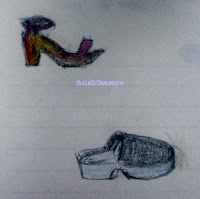
Platform shoes were in then however, they would not be suitable these days considering my height. Well, it does not mean I did not have a pair of those years ago. Another type of shoe-ware that was popular in Europe in the 70s was the clogs. I quite like them. I did leave behind in Poland two pairs of those (with wooden bottom part) - black and white ones. Nowadays, I would still wear the clogs, if I had them here.

Clogs

  •  A lighter option with a rubber sole - here,
  •  A bit more expensive - genuine Swedish leather and wooden clogs here.


My other pick as an everyday style item are the sandals. In the 70s, their sole was made of wood. The modern version has it made of rubber.

  • Brown sandals - here


Headcover

is a must. I might have lived in the times where all the adults wore hats, well, my head likes to be covered. Although it is a matter of style as well.


  • Floppy hat - red or camel - here.


Accessories  

To complete the look.


  • Flower Heart necklace - metal, glass, and plastic - here.  
  • Metal, gold chain belt - here. To be worn on the hips (on the T-shirt for example).
  • Hand-made bracelet, leather, and beads - here. I like the colors, not sure about the healing part, though.
  • Optional - a set of metal bangles (worn instead of the bracelet of course) here
  • Or plastic ones, if you do not like the metallic sound of the bangles here.


To see all the items, mentioned above, that I have found at amazon.com - have a look at my Pinterest board (below).


Saturday, January 29, 2022

My Texas Alphabet: B for Bandera

In the second edition of "My Texas Alphabet", B is for Bandera.

Nowadays, Bandera is mostly known/advertised as "the cowboy capital of the world". Not many people have any idea about its origin and that some of the town's first inhabitants were 16 Polish families who came to Texas from Silesia.

 
Local cattle brands

The intended destination of those Silesians was originally the settlement of Panna Maria, where they arrived in 1855. Since the land in that area had already been taken, the immigrants tried to find land around Castroville. It was Charles de Montel, who persuaded those Silesian families to go to Bandera where they could find employment at de Montel's  (saw and shingle) mill.
 

Charles de Montel was born in Königsberg, Prussia. He was a lawyer, soldier, engineer, and commander of Texas Rangers company. The man supplied the Polish immigrants with ox-driven carts so that they could relocate their belongings to the designated place. 
 
Frontier Times Museum, Bandera, TX

In Bandera, the Polish men worked for Charles de Montel. They also obtained town lots and land that they systematically cleared. The women worked at the local gristmill, which belonged to the Mormons, and helped with the farmland cultivation.
 
St. Stanislaus Church, Bandera, TX

In 1858, the Poles constructed St. Stanislaus Church in Bandera (the second oldest Polish church in America) - I have already written about the church in one of the previous posts. At first, the church building was a log structure. Years later, a rock church replaced the original one. In 1874, the Sisters of the Immaculate Conception opened a Polish school there.
 
The building of the Polish parochial school in Bandera
 
We have visited Bandera a few times - enjoyed watching a parade and ProRodeo there. We also went to the Frontier Times Museum (among others). People seemed nice and friendly there. 
 

It could be also a good place to settle (depending on what you look for).


Source: 
"The Texians and the Texans. The Polish Texans" The University of Texas, Institute of Texan Cultures, 1972.

Our Facebook page posts:
St. Stanislaus Church - our photos

History notes:
More about Bandera here
More about Charles de Montel: here
 

In the previous edition of "My Texas Alphabet", B was for Beans

Thursday, January 27, 2022

Pastor Dangers & Family

Gottlieb Burchard Dangers was born on 11 October 1811 in the town of Langenhagen, which was then, in the Electorate of Hanover.

Langenhagen is situated not far from the main city of the region (10 minutes by train).
 
Map data ©2022 Geo-BasisDE/BKG (©2009), Google United States

At the time when Gottlieb was born, the Electorate was part of the Kingdom of Westphalia whose Elector was King George III, King of the United Kingdom of Great Britain and of Ireland. In 1814, the Electorate became the Kingdom of Hanover, King George III was still its official ruler, however, due to his mental illness, a regency controlled the state matters. Later, the sons of George III, George IV (in 1820), William IV (in 1830), and Ernest Augustus (in 1837) succeeded him on the throne of the Hanoverian Kingdom (1).


Gottlieb Dangers became a pastor. In 1845 he married Miss Mathilde Max (born in December 1822). Soon after their marriage, the couple went to Bremen (possibly by train), they were emigrating to Texas.

 
Map data ©2022 Geo-BasisDE/BKG (©2009), Google United States
 

Mathilde and Gottlieb's journey most likely took them next (by the Wesser River?) to the port of  Bremerhaven (operating since 1830).


Map data ©2022 Geo-BasisDE/BKG (©2009), Google United States
 

Gottlieb and Mathilde were going to spend their honeymoon at sea, on their way to America. 

On 10 October 1845, their ship, Brig Johann Dethardt started their journey to America. Pastor Dangers led religious services during the voyage. After about 3 perilous months, on 12 January 1846, they arrived in Galveston, where the Dangers couple and other immigrants stayed for about six weeks. Next, with a group of about 700 people, Gottlieb and Mathilde relocated to Indianola. It took them 2 weeks before they moved again. That time, it was an 11 day trip to New Braunfels. Gottlieb worked there as a day laborer, trying to make ends meet and make some money for further investment. 
 

At the end of 1846, Gottlieb received financial help from his relatives in Germany. The money he was sent was enough to buy land at the Guadalupe River. In 1847, Gottlieb Dangers owned 16 acres there. The land was originally granted to AC Horton (2).

Gottlieb and Mathilde's first daughter Theodora was born on 16 March 1848. In the same year, Dangers had 17 acres of land which was worth $50. The man had one horse as well (3).


A year later Mr. Dangers was taking care of 25 acres (still worth $50), had one horse, and 4 head of cattle (4).

In 1849, Gottlieb and his family moved to Fredericksburg. He obtained a town lot at West Creek/West Peach Street. The man started his ministry service as Pastor of the Evangelical Protestant Church in the town.

1850 - Gottlieb owned 7 town lots in Fredericksburg which were situated at 4 blocks, no. 42, 60 (?), 61, and 30 (5). The man built a house in the area where the nowadays St. Mary's Catholic School is. Besides, being a pastor, he also farmed and taught (until the end of 1851) at the Vereins Kirche School as well.


The second daughter Minna was born in about 1850.


On 13 May 1851, Pastor Dangers was granted American citizenship. Gottlieb and his wife brought a piano from the old country and they enjoyed making music together. Mr. Dangers played the flute and the zither. He not only organized a local male music quartet but also composed music pieces. Unfortunately, the compositions created by pastor Dangers were never published (most probably got lost ?).

Mathilde was born in 1852.

Another daughter, Franziska, was born on 29 September 1855 (6).


1855 - B Dangers had 160 acres of land (worth $160), owned 7 town lots (from no. 307 to 310, no. 423, 441, and 442), had 1 horse and 16 head of cattle (7).

The tax report from the next year shows a change - Burchard must have sold most of his land as, according to the record, besides the town lots mentioned above, he had only 20 acres, owned 2 horses, and 12 head of cattle (8).


1857 - that year, Mr. Dangers farmed 40 acres of land, had town lots from no. 307 to 310, from no. 423 to 426, no. 423, 441, and 442 had 3 horses, 18 head of cattle, and 1 wagon (9).


In the same year, the first son of Gottlieb and Mathilde was born. They named him Burchard.


Census 1860 - 21 June, the family of Burchard Dangers, protestant minister (his wife Mathilde and 5 children) were recorded in the 2 Precinct of Gillespie County (Fredericksburg). Their closest neighbors were Bernhard Meckel, a cooper + his family, and Ms. Barbara Meurer and her sons Peter (a wagoner) and Adam (10). 


♦ The year 1861 brought diphtheria and a tragic time to the Dangers family. The disease took 3 of their children (including the only son)  within 5 days in February. About a month later, another child died. Theodore, Minna, Mathilda, and Burchard were no more. Of all Gottlieb's kids, only 5-year-old Franziska survived the plague. It is hard to imagine the pain the parents dealt with. Mathilda Dangers, the babies mother was pregnant then.

 
On 3 August 1861, daughter Augusta was born.

In that year B Dangers paid taxes for 40 acres of land, town lots from no. 307 to 320, no. 441, 442, and 423, 2 horses, and 25 head of cattle (11).


During the Civil War, pastor Dangers taught at the Vereins school again. He worked as the town minister for twenty years. At the end of his life, Gottlieb Burchard contracted pneumonia. He had got socked wet, caught by the storm and rain when he was coming back from the ministry service in the country. The man passed a few days later, on 12 November 1869 (12). He was 58 years old. Pastor danger's body was interred in the City Cemetery in Fredericksburg.


14 June 1870 - another Census - Mathilda Dangers lived with the two daughters - 14-year-old Franziska and 9-year-old Augusta. Their closest neighbors were the family of Paul Loeffler, William Jordan, his wife, daughter and mother-in-law, and Father Tarrillon (13).


10 months later, on 2 April 1871 (14), young Franzisca married about 8-year-older Mr. Peter Kraus (born 5 August 1848), the son of Anton and Elizabeth Kraus.


Augusta Wilhelmina H Dangers started her own family when she was about 23, on 12 June 1884 in Colorado, Texas (15). Her spouse was Mr. John Sandilands (born on 22 December 1855 in Edinburgh, Scotland). John was the son of Edward Sandilands and Agnes Gilbraith (16). 


After Augusta's marriage, her mother Mathilda lived with the youngest daughter and her folks.

The 1900 Census registered Augusta, her husband John, their 14-year-old Edward B (born in New York), Mathilda Dangers, and a boarder, Mr. David A Burchfield. They all lived in Galveston. The record reads that Mr. John Sandilands was a compositor (17). 


Mathilda Dangers, Burchard's wife, lived 83 years. She passed on 6 May 1906 in Galveston and was buried in the city Lakeview Cemetery.


Source:

Google maps;

"Pioneers in God's Hills. A History of Texas and Gillespie County People and Events." 1960, Gillespie County Historical Society. Printed by Boeckman-Jons, Austin, Texas.

1. Wikipedia.com
2."Texas, County Tax Rolls, 1837-1910", database with images, FamilySearch (https://familysearch.org/ark:/61903/1:1:Q2QG-D54Q : 20 February 2021), B Dangers, 1847.
3. "Texas, County Tax Rolls, 1837-1910", database with images, FamilySearch (https://familysearch.org/ark:/61903/1:1:Q2QG-DYM6: 20 February 2021), Burchard Dangers, 1848.
4. "Texas, County Tax Rolls, 1837-1910", database with images, FamilySearch (https://familysearch.org/ark:/61903/1:1:Q2QG-DTNQ: 20 February 2021), Burchard Dangers, 1849.
5. "Texas, County Tax Rolls, 1837-1910", database with images, FamilySearch (https://familysearch.org/ark:/61903/1:1:QJ85-RX99 : 20 February 2021), B Dangers, 1850.
6. Findagrave.com
7. "Texas, County Tax Rolls, 1837-1910", database with images, FamilySearch (https://familysearch.org/ark:/61903/1:1:QJ85-RJSP: 20 February 2021), Burchard Dangers, 1855.
8. "Texas, County Tax Rolls, 1837-1910", database with images, FamilySearch (https://familysearch.org/ark:/61903/1:1:QJ85-RNL4 : 20 February 2021), B Dangers, 1856.
9. "Texas, County Tax Rolls, 1837-1910", database with images, FamilySearch (https://familysearch.org/ark:/61903/1:1:Q2QG-D54Q : 20 February 2021), B Dangers, 1847.
10. "United States Census, 1860", database with images, FamilySearch (https://familysearch.org/ark:/61903/1:1:MXFX-KRS: 18 February 2021), Minna Dangers in entry for Barchhard Dangers, 1860.
11. "Texas, County Tax Rolls, 1837-1910", database with images, FamilySearch (https://familysearch.org/ark:/61903/1:1:QJ85-R23X : 20 February 2021), B Dangers, 1861.
12. Texas handbook Online
13. "United States Census, 1870", database with images, FamilySearch (https://www.familysearch.org/ark:/61903/1:1:MXL5-5KB : 24 January 2022), Francisca Dangers in entry for Marta Dangers, 1870.
14. "Texas, County Marriage Records, 1837-1965," database with images, FamilySearch (https://familysearch.org/ark:/61903/1:1:K61K-JVT : 23 February 2021), Peter Kraus and Franciska Dangers, 02 Apr 1871; citing Marriage, citing Bexar, Texas, United States, Texas State Library, Archives Division, and various Texas county clerks; FHL microfilm 24,919.
15. "Texas, County Marriage Index, 1837-1977," database with images, FamilySearch (https://familysearch.org/ark:/61903/1:1:QK8T-2363 : 10 March 2021), Jno Sandilands and A W H Dangers, 12 Jun 1884; citing Colorado, Texas, United States, county courthouses, Texas; FHL microfilm 969,534.
16. "Scotland Births and Baptisms, 1564-1950", database, FamilySearch (https://www.familysearch.org/ark:/61903/1:1:FQBL-WDZ : 16 September 2021), John Sandilands, 1855.
17. "United States Census, 1900", database with images, FamilySearch (https://www.familysearch.org/ark:/61903/1:1:M3GC-LDV : 14 January 2022), Mathilda Dangers in entry for George Sandilands, 1900.
 

Monday, January 17, 2022

A for Amber

Soon, I will get to the "B" entries in "My Polish Alphabet".  For those of you who are not familiar with the series - the Alphabet is about things, places, and people that come to my mind when I think about Poland.

Since I have reminded myself about another "A", today

A is for Amber


The part of Poland in which I used to live is rich in amber. After a storm, the Baltic Sea throws on its beaches small, brownish pebbles - raw amber. If you are lucky, you can find a bigger piece as well. It is said that raw amber contains positive energy, which is why wearing jewelry made from raw amber may be beneficial for one's health. Pieces of raw amber are also one of the ingredients of a tincture used by some for medicinal purposes.

Polished amber is a totally different matter - polishing turns a dull stone into a pretty gem. In the Baltic area of Poland, there are many jewelers shops and jewelry stores that offer amber items. Most often, the polished, old, congealed resin is framed in sterling silver. Personally, besides typical brown/yellow amber, I like the red and also the green version of it most.

When in Texas, I once was browsing through a catalog of an online jewelry store based in one of the US states. They happened to have amber jewelry made in Poland. What really surprised me, however, was the information given in the item description. It claimed that in Poland, amber jewelry is a traditional "good luck" gift for a bride on her wedding day. I found it quite stunning. Why? Well, I had lived in Poland for quite a few decades, attended weddings there, and never had I heard of such a wedding custom. I guess the retailer created that story to increase the sales of their products. Or it is me who is uninformed?

All in all, amber jewelry is a good but rather pricey gift for any occasion. I would certainly appreciate it!

In Gdańsk, there is a museum of amber (which we have visited as well). In the museum, you can see very interesting artifacts on display, including amber crumbles with insects that drowned inside the resin ages ago. There, you can learn about the history of amber as well.

By the way, do you know that amber is commonly called "Baltic gold/gold of the Baltic Sea"?
 
 To go to the Website of the Museum of Amber in Gdańsk - click here

One of the Baltic Sea sandy beaches in Poland


Wednesday, January 12, 2022

Rev. John Webb Montague and His Family Line

18-year-old Peter Montague came to America from England in 1721. He was born in 1603, in the hamlet of Boveney, Burnham, Buckinghamshire. His parents, Peter and Elizabeth Montague, were of noble descent. 
 
St. Mary's Church, Boveney, England*

The Montagues had family connections to the royal families of Europe. Boveney, the seat of the Montague family, was situated 23 miles north of London, not far from Eton College. 
 
Eton College, England**
 
Peter received a good education. Interestingly, his uncle William studied at Eton, Cambridge, and Kings College as well. Peter was the second son of Peter and Elizabeth Montague. William was their oldest child. Then, there were also Richard and Robert (younger than Peter), and three girls by the names Elizabeth, Margaret, and Ann.
 
Peter Montague, Sr. was an agriculturist and raised different types of livestock.

Peter's oldest brother William most likely inherited their father's goods and the house. Both Peter and his younger brother Robert decided to look for their fortune in the New World. Peter traveled on the ship "Charles" together with 1300 emigrants including the person of Sir Francis Wyatt who became the governor of the colony in Virginia. In November 1621, upon his arrival in the new land, Peter was sold for the passage debt - he had had no money to pay for the voyage, so later, the young man had to work off his debt. Since he was not used to hard labor, painful blisters quickly appeared on Peter's hands. During the time of recovery, he was caught reading his master's books (written in Latin). Soon afterward, Peter was appointed a school teacher. It is likely that he was one of the very earliest school teachers in Virginia.
 

In 1624, Peter Montague was recorded as a resident of the plantation in James City. The place was owned then by Capt. Samuel Matthews. 

On 22 August 1637, Peter was granted 150 acres in New Norfolk (Upper County). It was a reward for inducing 3 persons (at Peter's expense) to emigrate to Virginia (50 acres for each person). On 28 February 1838, Peter received another 50 acres, and on 18 December 1845, 150 acres more. On 3 November 1647, the man bought 100 acres of land in Nansemond County. By that time, Peter Montague had probably been married. The civil records from those times got lost, but it is known that in 1652/53, the man lived in Nansemond. Peter Montague was the County representative in the House of Burgesses in those years. From 1851 to 1857, he represented County Lancaster in that Assembly.
 

During his life in Virginia, Peter grew from being a conscripted laborer and the man of no means to a respected citizen of good social and financial status, a man of influence. At the end of his life, Peter's health deteriorated. He died at the age of 56, on the last day of April or 1 May in 1659. At the time of the man's passing, his wife was Cicely Montague. Possibly, Peter's first wife was Hannah, who passed before 1659.

Peter's children were William, Peter, Ann, Margaret, Elizabeth, and Ellen (Eleanor).
  • Anna, born about 1630 - married John Jadwin. Anna had one daughter. The lady died before her father Peter.
  • Ellen (Eleanor) - born about 1632, married William Thompson.
  • Peter - born about 1634/died January or February 1702,
  • Elizabeth - born about 1636,
  • William - born about 1838,
  • Margaret - born about 1840.

From Peter the Emigrant to John Webb Montague


Peter

his son Peter
his son William, born between 1670/1674, Lancaster or Middlesex County, Virginia + wife Lettice
their son Abraham, baptized 28 September 1701 in Christ Church, Middlesex, VA/d. June or July 1670 + wife Charlotte Latané
their son Latané Montague, born about 1731, Essex County, Virginia/ died about 1813, NC + wife Catherine Young Taylor
their son William, born in about 1760, Granville County, NC/died 6 April 1814 + wife Mary Owen
their son Thomas born on 7 December 1795, Granville Co., NC/d. 1 February 1860, Wayne County + wife Mary Owen Webb
their son John Webb Montague, born on ( 9 November 1823, Wayne County, Tennessee)
 

John Webb grew up on the family farm. The boy did not get much education, everything that was needed to be done on the farm, he learned at home. At the age of 23, on 27 January 1846, John married Miss Matilda Jane Grimes who was born on 3 June 1825 in Maury County, Tennessee. Matilda was the daughter of Wilson Grimes and Rachel Carr.

15 November 1846 - the first son was born to John and Matilda. They called him James Webb.
Two years later, on 8 September, the first girl came to the family. Her name was Mary Ann.
 

In 1850, the Census found John, Matilda, and their 2 children in Wayne County, Tennessee. John was a farmer, a 16-year-old Jess Carr (possibly Matilda's relation from her mother's side) lived with the family (1).

In 1853, John Webb Montague became a member of Philadelphia Baptist Church. Soon he found his life call - he worked as a preacher of the missionary Baptist Church.

Thomas Wilson was born on 14 July 1857.


Three years passed, and another Census took place. John Webb Montague, his wife Matilda, and their kids lived in the 4th District of Wayne County. Matilda's father's house was next to the Montagues' place (2).

John Henry Young came to this world on 25 January 1861.

According to the source given below*, during the Civil War, Rev. John W Montague joined the Confederate Army as a replacement for his brother. The latter needed to attend to his sick wife. John Webb was assigned to Company F of the Gantt's 9th Cavalry Battalion of Tennessee (3).
 

In 1862, Private John W Montague was with his unit at Fort Donelson. After its fall, John Webb was taken prisoner on 16 February, and with 2,500 other Confederate soldiers (4), the man was sent to Camp Butler near Springfield, Illinois. The living conditions in the overcrowded camp were quite horrible. A few months later, on 15 May 1862,  John died from exposure to the weather elements (4). He was 38 years old.
 

 Private John Webb Montague was buried (5, 6) at the Camp area (Plot 515. R. No. 1)


Two years after his father's passing, in August, 18-year-old James Webb joined Company F of the 9th Regiment of Tennessee Cavalry. He was with the CA army at Gainesville, Alabama. After the battle, James Webb Montague was left behind as he was believed to be dying. The man was sick. Despite that, he managed to walk back home/begged during that time to survive.


Matilda Jane Montague, John's wife, married again (twice). At the end of her life, she suffered from a stroke and paralysis. Matilda passed on 6 August 1886.

From John Webb Montague to our cousin

 
John Webb
his son James Webb Montague
his wife Sarah Emma "Sallie" (Gant) Montague, born on 20 July 1846, Martin Mills, Wayne, Tennessee/died 8 June 1880, Gainesville, TX - our second cousin five times removed
her father Absolom Bobo Gant - our first cousin six times removed.

Resources:
 
Photos:
* Boveney St. Mary's Church, Irid Escent, CC BY-SA 2.0 <https://creativecommons.org/licenses/by-sa/2.0>, via Wikimedia Commons
** Eton College, Alwye, CC BY-SA 4.0 <https://creativecommons.org/licenses/by-sa/4.0>, via Wikimedia Commons 

-----
  • "History and genealogy of Peter Montague of Nansemond and Lancaster Counties and his Descendants 1621-1894", George William Montague, Amherst, Mass., USA: Press of Carpenter and Morehouse, 1894.
  • Wilson Grimes Genealogy

1. "United States Census, 1850," database with images, FamilySearch (https://www.familysearch.org/ark:/61903/1:1:MC6S-L8S: 23 December 2020), John Montague, Wayne, Tennessee, United States; citing family, NARA microfilm publication (Washington, D.C.: National Archives and Records Administration, n.d.).
2. "United States Census, 1860", database with images, FamilySearch (https://familysearch.org/ark:/61903/1:1:M8TY-N38: 18 February 2021), John Montague, 1860.
5.United States Records of Prisoners of War, 1861-1863
  • Camp Butler, Military Prison, Prisoner captured, confined & exchanged registers, 1862-1863, v. 48-52
  • 6. Camp Butler National Cemetery