This post is a tribute to our Friend, Chris who has passed away suddenly this week.

God bless you, dear Friend, travel well.


This post is a tribute to our Friend, Chris who has passed away suddenly this week.
God bless you, dear Friend, travel well.

"N" is for the Narrow Gauge Railway Museum in Wenecja, which we visited some years ago.
 |
| Wenecja means Venice in Polish |


 |
 | |||
There is not much space to seat on the narrow gauge trains and the seats are rather narrow. Carts and the engines are smaller too.


The museum collection consists of several steam locomotives. The oldest one was made in 1899, and others in the early 1900s.


 |
| Post office cart |
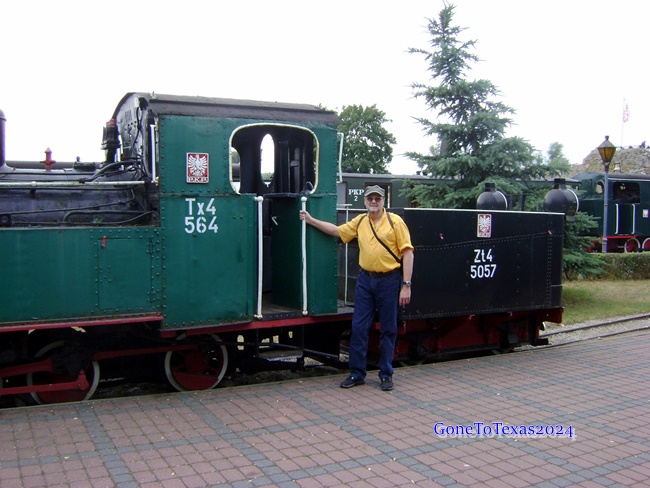
The locomotive in the above photo was made in Hannover in 1923.
There is also the old station-waiting room and ticket office.


From the museum area, you can also see the ruins of the castle in Wenecja (the structure was built in the 14th century).


A good place to visit with the family as well.

Arkady Fiedler (1894/1985) was a Polish writer, traveler, and naturalist. During his life, the man took part in numerous expeditions to several countries on all continents.

Some years ago, I happened to see the museum situated in Fiedler's family home in Puszczykowo (not far from Poznań, Poland), and I did enjoy watching all the exhibits there. The small items are on display in the house. Others, placed in the yard, are interesting reconstructions.

Some of the structures are:
a statue from Easter Island,
a monument to Crazy Horse, Lakota chief,
Sitting Bull statue,
and the Gate of the Sun (Lake Titicaca area, Bolivia).


The place is worth visiting, but probably not many people know about it.

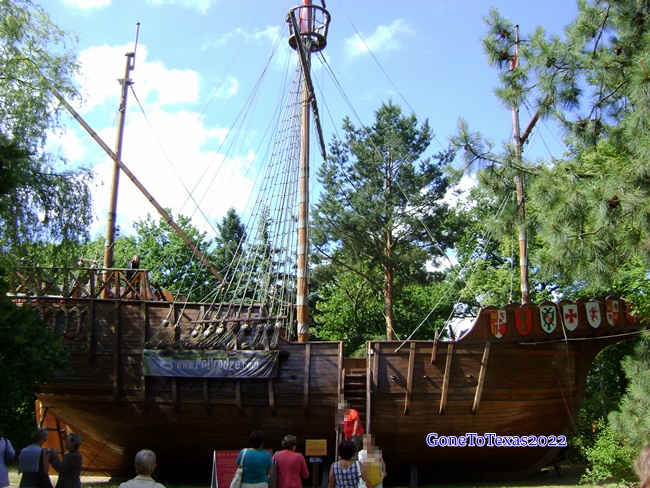 |
| Santa Maria - replica |

"The River of Singing Fish" ("Ryby Spiewają w Ukajali") about his trip to South America, bought by my sister, we had at home.

---
"My Polish Alphabet" is related to things, places, and people that come to my mind when I think about Poland.
The letter "C" in "My Polish Alphabet" is for Ciechocinek.

Ciechocinek /tche:hotcheeneck/, situated in the Kuyavian-Pomeranian Voivodeship, Poland, is a spa town known for its brine sources and related to them graduation towers built 1824/1859.

A graduation tower is used in the production of salt. The process removes water from a saline solution by evaporation. The result is an increased concentration of mineral salts in the product. The tower consists of a wooden wall-like frame stuffed with bundles of brushwood. In Ciechocinek, the brushwood is blackthorn. The wigs have to be changed every 5/10 years. Anyhow, the saline water is pumped up the tower, then runs down the twigs and partly evaporates. At the same time, some minerals from the solution are left behind on the brushwood (1).

There are three graduation towers in Ciechocinek which are 15.8 m/52 ft high. The second one is the longest (719 m/2,359f t long). They are the largest graduation towers in Europe (there are smaller ones in France and Germany).
How it works
The brine solution goes from one tower to another and another, and the concentration of the brine gets greater and greater. The final product of the graduation towers' work is a 30 % brine concentration. From the last tower, the saline water goes by pipes to a salt plant where besides salt, therapeutic lye and sludge are manufactured (2).


During the stroll (over 2km/6,000 ft), we could see particles of salt accumulated at the bottom of the towers. Of course, we collected a few pieces as a keepsake.
 |
| Salt of course |
 |
| The base of the tower is made of oak wood |
 |
| More salt |
Inside the last tower, where the concentration of the brine is the biggest, there was an inhalation chamber. The entrance fee was 5zł. We climbed up the wooden wall and, for 30 minutes, sat there watching the brine solution going down the wall and inhaling the healing air.
 |
| Brine going down the wall inside the tower |
 |
| Salt collected at the bottom of the tower |

Standing there, we could feel the brine solution dripping everywhere. The tiny drops refreshed the skin.

It was amazing how much easier breathing was afterward.
In the town, there are spa hotels. In one of them, they had a warm saline water pool, with currents massaging the body. The water is too thick to swim in it, so people just sat there enjoying the warm massage.


It was another very, very long walk we did while visiting Poland. Afterward, our legs needed to rest, so we enjoyed sitting in the town spa park.


Sources:
1. Wikipedia
2. Ciechocinek graduation towers
You can find more letters of "My Polish Alphabet" here.


 |
| 'Death gate' leading to the camp |
 |
| Prisoners' shoes |

 |
| Crematoria |
 |
| Gas chamber |
 |
| #1 camp surgery/death room, #2 art by a prisoner |


